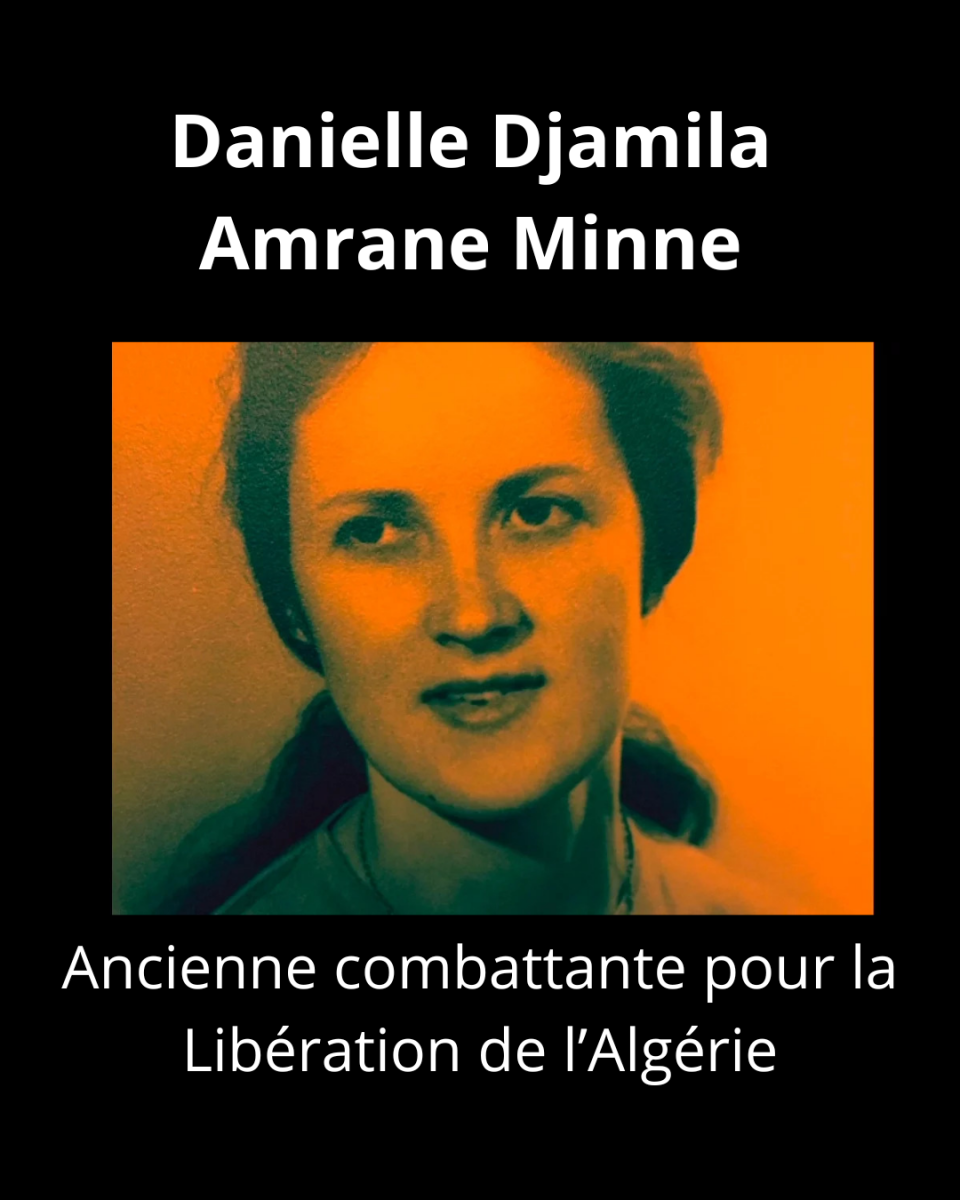

Danielle Djamila Amrane Minne, ancienne combattante pour la Libération de l’Algérie
(english version bellow) Danièle Djamila Amrane Minne.
Ancienne combattante pour la Libération de l’Algérie,
Algérienne d'origine européenne, fille de Pierre Minne surréaliste, libertaire et d'une mère communiste, elle-même combattante de la liberté, Jacqueline Guerroudj.
Djamila Amrane était une moudjahida, une historienne, une mère et une poétesse.
On lui doit une thèse publiée sur les engagements de femmes dans la guerre de libération de l'Algérie, basée sur 88 entretiens avec des femmes résistantes. Ses ouvrages sont des références incontournables. Avoir partagé des faits d’armes avec celles qu’elle interviewait, tout en ayant une solide formation universitaire, la plaçait à un endroit qui défie la soit-disant neutralité académique. Son travail est précisément profond de cette double formation acquise à l'université et au maquis.
Elle fut agent de liaison, maquisarde, fidaya.
Elle a risqué sa vie pour cet idéal partagé de libération - l'on peut être très sérieux quand on a 17 ans - et ce, en pleine bataille d’Alger.
Elle a récolté patiemment et avec acuité les récits de ses femmes, de cette "mafia des moudjahidate", comme je l'ai entendu nommée en Algérie, avec tendresse.
Pour ma part, Djamila est la première personne que j'ai interviewée pour un documentaire et la première à m'avoir fait confiance en tant que réalisatrice : à m'ouvrir ses cahiers, ses archives, son carnet d'adresses, sa maison et finalement son affection pour faire ce film Moudjahidate.
Son regard lumineux, exigeant, attentif et pétillant m'a accompagné avec patience et douceur dans cette quête de transmission de cette mémoire des femmes dans cette lutte anti-coloniale.
Djamila est devenue une grand-mère de cœur pour moi, une ancêtre, une inspiration dans mon arbre généalogico-politique, l’incarnation d’une possible trajectoire politique.
Une jeune femme blanche rompt avec le système colonial qui la privilégie, le court-circuite pour se placer aux côtés des colonisé.es qui se soulèvent.
Elle s'est engagée et a pris les risques nécessaires pour porter la lutte au même titre que les autres Algériennes : les transports d'information et d'armes pendant la bataille d'Alger, infirmière au maquis, et puis encore debout en prison comme à celle de Rennes, où elle maintiendra avec ses camarades suffisamment la pression auprès du directeur pour obtenir l'accès à la presse, à l’instruction : il fallait préparer l’avenir du pays indépendant.
Djamila aurait refusé que son origine européenne, c’est-à-dire le fait d'être blanche socialement, lui confère plus d'égards ou de reconnaissance pour son engagement. Pas si ces égards ne furent pas collectifs. Elle m'a accompagnée dans la réalisation de ce film parce que, précisément il s’agissait d’interroger la définition de ce qu’est un militant ou une militante. Une définition « qui n’est pas toujours évidente », une définition qu’il s’agissait d’élargir pour revaloriser tous les actes du quotidien et ceux déconsidérer car vu comme "normaux", souvent pris en charge par des femmes : soigner les blessé.es aux maquis, nourrir et cacher des militant.es, transporter des documents, ou encore mettre son bébé dans les bras d’une moudjahida pour qu’elle puisse passer plus facilement un checkpoint : des actes sans armes, essentiels, qui sont légion.
Son écriture d’une histoire collective remettait en question les personnifications de l’héroïsme : le peuple entier était le héros.
Djamila ressemblait physiquement à ma grand-mère bretonne, elle aussi décédée, Paix à leurs âmes.
Dans cette ère où règne le droit, non plus international, mais celui du plus fort,
dans ces moments de gorge serrée et d’angoisse profonde, comme l’état du monde et celui de la société française peuvent nous plonger,
je sais que son héritage et sa force m’accompagnent,
se déposent sur moi et sur sa famille, ses magnifiques enfants et petits-enfants.
Est-ce qu’on peut faire parler les fantômes ? Qu’aurait-elle à nous dire et à nous apprendre sur le monde d’aujourd’hui ?
Ce qui est certain, c’est qu’elle serait vocale sur les colonialismes et sur le génocide en cours perpétué par Israël sur le peuple palestinien.
Le dirait-elle par sa poésie ? Par une étude comparative sociohistorique sur la place des femmes dans la lutte en Algérie et dans celle en Palestine ? Trouverait-elle des analogies dans le traitement médiatique des résistances palestiniennes et celles du FLN à l'époque dans les médias français ? Parlerait-elle des techniques de tortures d’État utilisées en Algérie et enseignées par le gouvernement français comme celles validées et acclamées au parlement israélien ?
Gageons qu'elle parlerait certainement du souffle et de la détermination que portait le peuple algérien dans la clandestinité et dans la rue, jusqu’à sa victoire.
Un souffle, une détermination, un sumud que l’on retrouve au milieu des ruines, dans les mots des Palestiniens et Palestiniennes encore debout.
On ne fait pas parler les fantômes, mais leur héritage déposé nous oblige, tout comme leur amour transmis d’un idéal et d’un pays.
Un idéal qui nous rappelle de construire l’avenir et de le prendre à bras-le-corps.
Tahia Djezaïr,
Tahia Falestine.
Alexandra Dols
5 juillet 2025
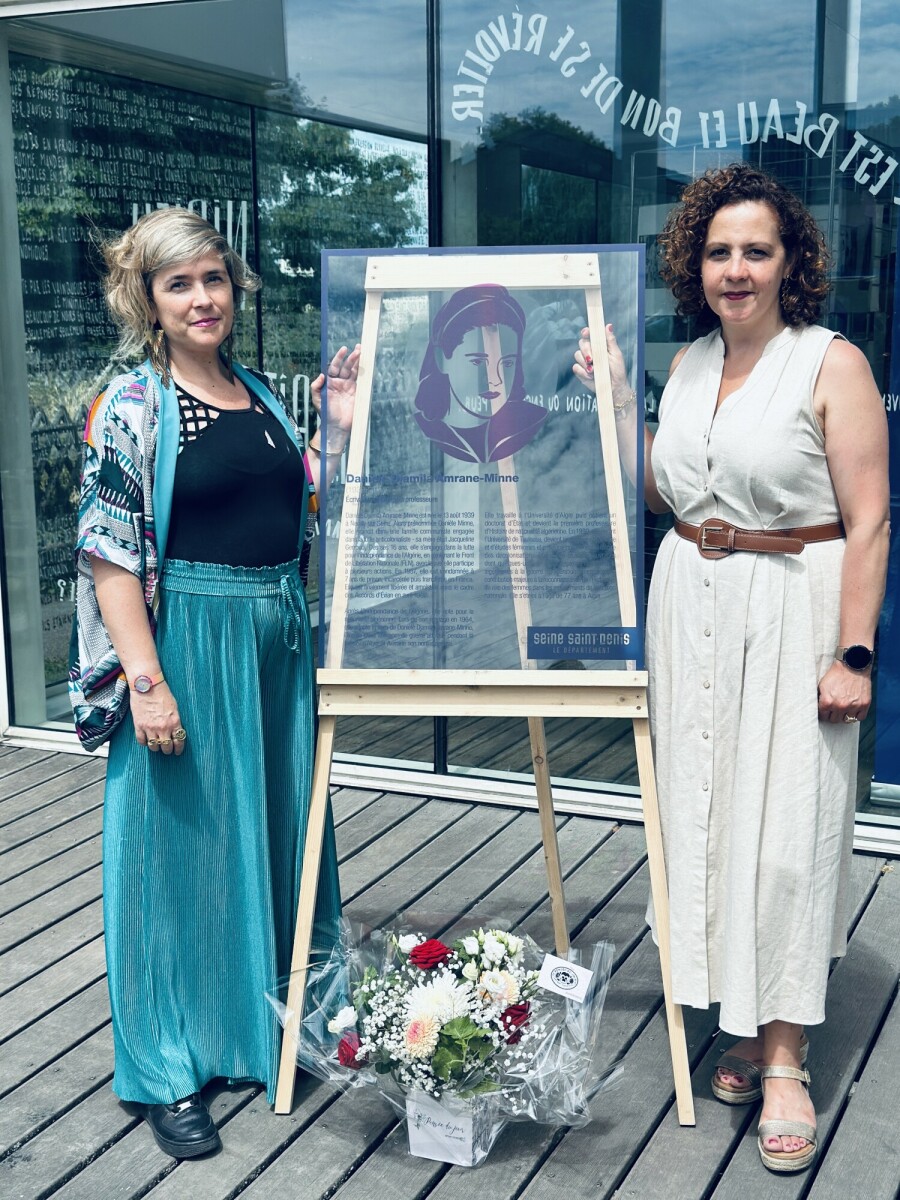
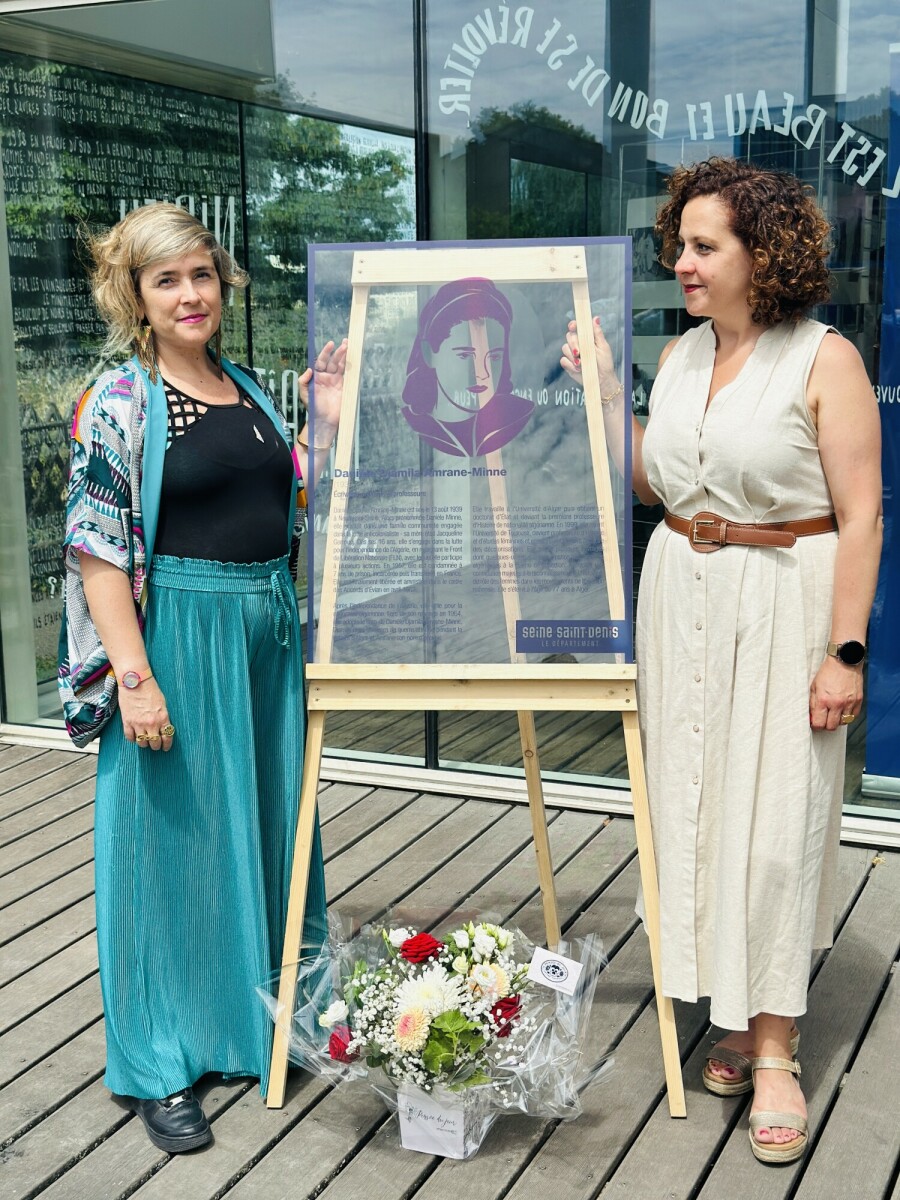
Femmage dans le cadre de la dénomination de la Maison du parc départemental de la Bergère à Bobigny, en Seine-Saint-Denis.
Quelques jours après, la maison de la culture a été vandalisée par des tags de néo nazis racistes "mort aux algériens" et des croix de l'OAS/Gud puis incendiée.
Près d'un an après, le département a restauré la maison et l'a inaugurée en juin 2026.
Le média Histoires crêpues en a fait un reportage.
En présence de
Stéphane Troussel, Président du Département de la Seine-Saint-Denis
Pascale Labbé, Vice-présidente chargée de l'Observatoire départemental des
violences envers les femmes et de l'Égalité Femmes-Hommes
Belaïde Bedreddine, Vice-président chargé de l'Écologie urbaine
Dominique Dellac, Vice-présidente chargée du patrimoine culturel, de la mémoire,
du tourisme et de l'éducation artistique et culturelle
Oriane Filhol, Conseillère départementale déléguée chargée de la jeunesse et de
la lutte contre les discriminations
================
Danièle Djamila Amrane Minne
A former fighter for the liberation of Algeria,
an Algerian of European origin, daughter of Pierre Minne, a surrealist and libertarian, and of a communist mother, herself a freedom fighter, Jacqueline Guerroudj,
Djamila Amrane was a moudjahida, a historian, a mother, and a poet.
She authored a published dissertation on women’s involvement in the Algerian War of Liberation, based on 88 interviews with women resistance fighters. Her books remain essential references. Having shared acts of struggle with those she interviewed, while also bringing a solid academic training, placed her in a position that defies so-called academic neutrality. Her work is deeply rooted in this double formation, acquired both at the university and in the maquis.
She was a liaison agent, a guerrilla fighter, a fidaya.
She risked her life for this shared ideal of liberation — one can be very serious at 17 — in the midst of the Battle of Algiers.
With patience and acuity, she gathered the accounts of these women, of that “mafia of the moudjahidate,” as I heard them affectionately called in Algeria.
For my part, Djamila was the first person I interviewed for a documentary, and the first to trust me as a filmmaker: to open her notebooks, her archives, her address book, her home, and ultimately her affection to me, in order to make this film, Moudjahidate.
Her luminous, demanding, attentive, and sparkling gaze accompanied me with patience and tenderness in this quest to transmit the memory of women in this anti-colonial struggle.
Djamila became a grandmother of the heart for me, an ancestor, an inspiration in my genealogical-political tree, the embodiment of a possible political path.
A young white woman breaks away from the colonial system that privileges her, short-circuits it, and takes her place alongside the colonized who rise up.
She committed herself and took the necessary risks to carry the struggle forward on equal footing with the other Algerian women: carrying messages and weapons during the Battle of Algiers, serving as a nurse in the maquis, and still standing in prison, as in Rennes, where, together with her comrades, she kept up enough pressure on the director to obtain access to the press and to education: the future of the independent country had to be prepared.
Djamila would have refused to let her European origin — that is, the fact of being socially white — grant her greater consideration or recognition for her commitment. Not if such consideration was not collective. She accompanied me in making this film precisely because it was a matter of questioning the very definition of what a militant is, or a woman militant. A definition “that is not always obvious,” a definition that had to be broadened in order to revalue all the acts of everyday life and those dismissed because they are seen as “normal,” often carried out by women: caring for the wounded in the maquis, feeding and hiding militants, transporting documents, or placing one’s baby in a moudjahida’s arms so she could more easily pass a checkpoint. These are essential acts without weapons, and they are legion.
Her writing of a collective history challenged the personalization of heroism: the whole people was the hero.
Djamila physically resembled my Breton grandmother, who had also passed away. May they rest in peace.
In this era where the rule of law no longer reigns internationally, but rather the law of the strongest,
in these moments of constricted throats and deep anxiety, such as the state of the world and that of French society can cast upon us,
I know that her legacy and her strength accompany me,
settling upon me and upon her family, her magnificent children and grandchildren.
Can we make ghosts speak? What would she have to tell us, to teach us, about the world of today?
What is certain is that she would speak out on colonialism in its various forms, and on the ongoing genocide carried out by Israel against the Palestinian people.
Would she say it through poetry? Through a socio-historical comparative study on the place of women in the struggle in Algeria and in Palestine? Would she find analogies in the media treatment of Palestinian resistance and that of the FLN at the time in the French press? Would she speak of the state torture techniques used in Algeria and taught by the French government, like those validated and applauded in the Israeli parliament?
We can be sure she would certainly speak of the breath and determination that carried the Algerian people in clandestinity and in the streets, all the way to victory.
A breath, a determination, a sumud that we find amid the ruins, in the words of Palestinians — women and men — still standing.
We do not make ghosts speak, but the inheritance they leave us obliges us, as does the love they transmitted, of an ideal and of a country.
An ideal that reminds us to build the future and to seize it with both hands.
Tahia Djezaïr,
Tahia Falestine.
Alexandra Dols
5 July 2025
A tribute on the occasion of the naming of the Maison du Parc départemental de la Bergère in Bobigny, Seine-Saint-Denis, July 5, 2025. Just days later, the Maison de la Culture was vandalized with racist graffiti—“Death to Algerians” and OAS/Gud crosses. CNews took great delight in denouncing the naming, declaring: “Honoring Danièle Djamila Amrane-Minne is neither inclusive nor reparative; in fact, it is quite the contrary.”
This femmage took place on the occasion of the naming of the Maison du parc départemental de la Bergère in Bobigny, Seine-Saint-Denis.
A few days later, the cultural center was vandalized with racist neo-Nazi graffiti reading “death to Algerians,” along with OAS/GUD crosses, and was then set on fire.
Nearly a year later, the department restored the building and inaugurated it in June 2026.
The media outlet Histoires Crêpues made a report about it.
In the presence of:
Stéphane Troussel, President of the Seine-Saint-Denis Department
Pascale Labbé, Vice-President in charge of the Departmental Observatory on Violence Against Women and Gender Equality
Belaïde Bedreddine, Vice-President in charge of Urban Ecology
Dominique Dellac, Vice-President in charge of Cultural Heritage, Memory, Tourism, and Arts Education
Oriane Filhol, Departmental Councillor delegated to Youth and the Fight Against Discrimination
En savoir plus
Ancienne combattante pour la Libération de l’Algérie,
Algérienne d'origine européenne, fille de Pierre Minne surréaliste, libertaire et d'une mère communiste, elle-même combattante de la liberté, Jacqueline Guerroudj.
Djamila Amrane était une moudjahida, une historienne, une mère et une poétesse.
On lui doit une thèse publiée sur les engagements de femmes dans la guerre de libération de l'Algérie, basée sur 88 entretiens avec des femmes résistantes. Ses ouvrages sont des références incontournables. Avoir partagé des faits d’armes avec celles qu’elle interviewait, tout en ayant une solide formation universitaire, la plaçait à un endroit qui défie la soit-disant neutralité académique. Son travail est précisément profond de cette double formation acquise à l'université et au maquis.
Elle fut agent de liaison, maquisarde, fidaya.
Elle a risqué sa vie pour cet idéal partagé de libération - l'on peut être très sérieux quand on a 17 ans - et ce, en pleine bataille d’Alger.
Elle a récolté patiemment et avec acuité les récits de ses femmes, de cette "mafia des moudjahidate", comme je l'ai entendu nommée en Algérie, avec tendresse.
Pour ma part, Djamila est la première personne que j'ai interviewée pour un documentaire et la première à m'avoir fait confiance en tant que réalisatrice : à m'ouvrir ses cahiers, ses archives, son carnet d'adresses, sa maison et finalement son affection pour faire ce film Moudjahidate.
Son regard lumineux, exigeant, attentif et pétillant m'a accompagné avec patience et douceur dans cette quête de transmission de cette mémoire des femmes dans cette lutte anti-coloniale.
Djamila est devenue une grand-mère de cœur pour moi, une ancêtre, une inspiration dans mon arbre généalogico-politique, l’incarnation d’une possible trajectoire politique.
Une jeune femme blanche rompt avec le système colonial qui la privilégie, le court-circuite pour se placer aux côtés des colonisé.es qui se soulèvent.
Elle s'est engagée et a pris les risques nécessaires pour porter la lutte au même titre que les autres Algériennes : les transports d'information et d'armes pendant la bataille d'Alger, infirmière au maquis, et puis encore debout en prison comme à celle de Rennes, où elle maintiendra avec ses camarades suffisamment la pression auprès du directeur pour obtenir l'accès à la presse, à l’instruction : il fallait préparer l’avenir du pays indépendant.
Djamila aurait refusé que son origine européenne, c’est-à-dire le fait d'être blanche socialement, lui confère plus d'égards ou de reconnaissance pour son engagement. Pas si ces égards ne furent pas collectifs. Elle m'a accompagnée dans la réalisation de ce film parce que, précisément il s’agissait d’interroger la définition de ce qu’est un militant ou une militante. Une définition « qui n’est pas toujours évidente », une définition qu’il s’agissait d’élargir pour revaloriser tous les actes du quotidien et ceux déconsidérer car vu comme "normaux", souvent pris en charge par des femmes : soigner les blessé.es aux maquis, nourrir et cacher des militant.es, transporter des documents, ou encore mettre son bébé dans les bras d’une moudjahida pour qu’elle puisse passer plus facilement un checkpoint : des actes sans armes, essentiels, qui sont légion.
Son écriture d’une histoire collective remettait en question les personnifications de l’héroïsme : le peuple entier était le héros.
Djamila ressemblait physiquement à ma grand-mère bretonne, elle aussi décédée, Paix à leurs âmes.
Dans cette ère où règne le droit, non plus international, mais celui du plus fort,
dans ces moments de gorge serrée et d’angoisse profonde, comme l’état du monde et celui de la société française peuvent nous plonger,
je sais que son héritage et sa force m’accompagnent,
se déposent sur moi et sur sa famille, ses magnifiques enfants et petits-enfants.
Est-ce qu’on peut faire parler les fantômes ? Qu’aurait-elle à nous dire et à nous apprendre sur le monde d’aujourd’hui ?
Ce qui est certain, c’est qu’elle serait vocale sur les colonialismes et sur le génocide en cours perpétué par Israël sur le peuple palestinien.
Le dirait-elle par sa poésie ? Par une étude comparative sociohistorique sur la place des femmes dans la lutte en Algérie et dans celle en Palestine ? Trouverait-elle des analogies dans le traitement médiatique des résistances palestiniennes et celles du FLN à l'époque dans les médias français ? Parlerait-elle des techniques de tortures d’État utilisées en Algérie et enseignées par le gouvernement français comme celles validées et acclamées au parlement israélien ?
Gageons qu'elle parlerait certainement du souffle et de la détermination que portait le peuple algérien dans la clandestinité et dans la rue, jusqu’à sa victoire.
Un souffle, une détermination, un sumud que l’on retrouve au milieu des ruines, dans les mots des Palestiniens et Palestiniennes encore debout.
On ne fait pas parler les fantômes, mais leur héritage déposé nous oblige, tout comme leur amour transmis d’un idéal et d’un pays.
Un idéal qui nous rappelle de construire l’avenir et de le prendre à bras-le-corps.
Tahia Djezaïr,
Tahia Falestine.
Alexandra Dols
5 juillet 2025
Femmage dans le cadre de la dénomination de la Maison du parc départemental de la Bergère à Bobigny, en Seine-Saint-Denis.
Quelques jours après, la maison de la culture a été vandalisée par des tags de néo nazis racistes "mort aux algériens" et des croix de l'OAS/Gud puis incendiée.
Près d'un an après, le département a restauré la maison et l'a inaugurée en juin 2026.
Le média Histoires crêpues en a fait un reportage.
En présence de
Stéphane Troussel, Président du Département de la Seine-Saint-Denis
Pascale Labbé, Vice-présidente chargée de l'Observatoire départemental des
violences envers les femmes et de l'Égalité Femmes-Hommes
Belaïde Bedreddine, Vice-président chargé de l'Écologie urbaine
Dominique Dellac, Vice-présidente chargée du patrimoine culturel, de la mémoire,
du tourisme et de l'éducation artistique et culturelle
Oriane Filhol, Conseillère départementale déléguée chargée de la jeunesse et de
la lutte contre les discriminations
================
Danièle Djamila Amrane Minne
A former fighter for the liberation of Algeria,
an Algerian of European origin, daughter of Pierre Minne, a surrealist and libertarian, and of a communist mother, herself a freedom fighter, Jacqueline Guerroudj,
Djamila Amrane was a moudjahida, a historian, a mother, and a poet.
She authored a published dissertation on women’s involvement in the Algerian War of Liberation, based on 88 interviews with women resistance fighters. Her books remain essential references. Having shared acts of struggle with those she interviewed, while also bringing a solid academic training, placed her in a position that defies so-called academic neutrality. Her work is deeply rooted in this double formation, acquired both at the university and in the maquis.
She was a liaison agent, a guerrilla fighter, a fidaya.
She risked her life for this shared ideal of liberation — one can be very serious at 17 — in the midst of the Battle of Algiers.
With patience and acuity, she gathered the accounts of these women, of that “mafia of the moudjahidate,” as I heard them affectionately called in Algeria.
For my part, Djamila was the first person I interviewed for a documentary, and the first to trust me as a filmmaker: to open her notebooks, her archives, her address book, her home, and ultimately her affection to me, in order to make this film, Moudjahidate.
Her luminous, demanding, attentive, and sparkling gaze accompanied me with patience and tenderness in this quest to transmit the memory of women in this anti-colonial struggle.
Djamila became a grandmother of the heart for me, an ancestor, an inspiration in my genealogical-political tree, the embodiment of a possible political path.
A young white woman breaks away from the colonial system that privileges her, short-circuits it, and takes her place alongside the colonized who rise up.
She committed herself and took the necessary risks to carry the struggle forward on equal footing with the other Algerian women: carrying messages and weapons during the Battle of Algiers, serving as a nurse in the maquis, and still standing in prison, as in Rennes, where, together with her comrades, she kept up enough pressure on the director to obtain access to the press and to education: the future of the independent country had to be prepared.
Djamila would have refused to let her European origin — that is, the fact of being socially white — grant her greater consideration or recognition for her commitment. Not if such consideration was not collective. She accompanied me in making this film precisely because it was a matter of questioning the very definition of what a militant is, or a woman militant. A definition “that is not always obvious,” a definition that had to be broadened in order to revalue all the acts of everyday life and those dismissed because they are seen as “normal,” often carried out by women: caring for the wounded in the maquis, feeding and hiding militants, transporting documents, or placing one’s baby in a moudjahida’s arms so she could more easily pass a checkpoint. These are essential acts without weapons, and they are legion.
Her writing of a collective history challenged the personalization of heroism: the whole people was the hero.
Djamila physically resembled my Breton grandmother, who had also passed away. May they rest in peace.
In this era where the rule of law no longer reigns internationally, but rather the law of the strongest,
in these moments of constricted throats and deep anxiety, such as the state of the world and that of French society can cast upon us,
I know that her legacy and her strength accompany me,
settling upon me and upon her family, her magnificent children and grandchildren.
Can we make ghosts speak? What would she have to tell us, to teach us, about the world of today?
What is certain is that she would speak out on colonialism in its various forms, and on the ongoing genocide carried out by Israel against the Palestinian people.
Would she say it through poetry? Through a socio-historical comparative study on the place of women in the struggle in Algeria and in Palestine? Would she find analogies in the media treatment of Palestinian resistance and that of the FLN at the time in the French press? Would she speak of the state torture techniques used in Algeria and taught by the French government, like those validated and applauded in the Israeli parliament?
We can be sure she would certainly speak of the breath and determination that carried the Algerian people in clandestinity and in the streets, all the way to victory.
A breath, a determination, a sumud that we find amid the ruins, in the words of Palestinians — women and men — still standing.
We do not make ghosts speak, but the inheritance they leave us obliges us, as does the love they transmitted, of an ideal and of a country.
An ideal that reminds us to build the future and to seize it with both hands.
Tahia Djezaïr,
Tahia Falestine.
Alexandra Dols
5 July 2025
A tribute on the occasion of the naming of the Maison du Parc départemental de la Bergère in Bobigny, Seine-Saint-Denis, July 5, 2025. Just days later, the Maison de la Culture was vandalized with racist graffiti—“Death to Algerians” and OAS/Gud crosses. CNews took great delight in denouncing the naming, declaring: “Honoring Danièle Djamila Amrane-Minne is neither inclusive nor reparative; in fact, it is quite the contrary.”
This femmage took place on the occasion of the naming of the Maison du parc départemental de la Bergère in Bobigny, Seine-Saint-Denis.
A few days later, the cultural center was vandalized with racist neo-Nazi graffiti reading “death to Algerians,” along with OAS/GUD crosses, and was then set on fire.
Nearly a year later, the department restored the building and inaugurated it in June 2026.
The media outlet Histoires Crêpues made a report about it.
In the presence of:
Stéphane Troussel, President of the Seine-Saint-Denis Department
Pascale Labbé, Vice-President in charge of the Departmental Observatory on Violence Against Women and Gender Equality
Belaïde Bedreddine, Vice-President in charge of Urban Ecology
Dominique Dellac, Vice-President in charge of Cultural Heritage, Memory, Tourism, and Arts Education
Oriane Filhol, Departmental Councillor delegated to Youth and the Fight Against Discrimination
En savoir plus